More on Sodachrome

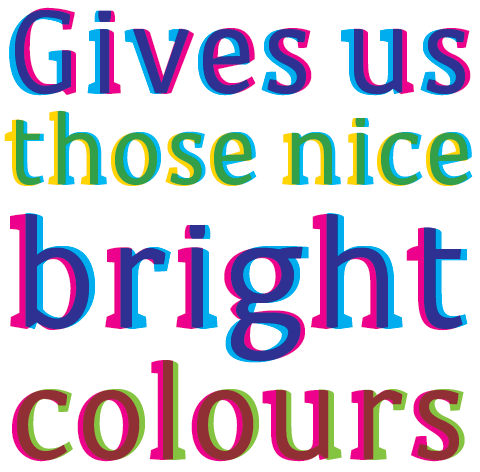
A few people have been asking about how Sodachrome actually works, and how a user would assemble the pieces to work properly. It’s actually a lot simpler than it might seem: no crazy OpenType features, no complex setting. It’s just two simple fonts that can be set independently, or — ideally — set on top of one another, either by overprinting separate color plates, or by using transparency modes to blend the layers if you’re going all-digital.

First, let’s have a quick peek at the first font — Sodachrome Left:

Sodachrome Left

And now, Sodachrome Right:

Sodachrome Right

Continue reading “More on Sodachrome”

The Colour Grey, revealed

I may have hinted at this before, but for a chunk of the last year, I have been collaborating with my good friend and fellow MATD alumnus Ian Moore on some type and graphic design projects. Need some bespoke type solutions for identities or publications, or help developing some lettering into a full typeface? Perhaps you could use the help of The Colour Grey.

Last Spring we were talking about what kind of work we’d like to do if we partnered up, and fantasized about landing a project that would let us experiment with unusual type solutions that could push the boundaries of how the type could be used, and even go beyond two dimensions in some way. In an almost alarming coincidence, the next day my friend Rathna asked if I’d liked to develop an typographic identity for an online shop selling products that celebrated the quirks and imperfections that are part of hand-crafted production. She wanted a typeface that would benefit from these surprises, especially with the inprecise nature of screenprinting. Bingo! Before we even had a name for ourselves, we had a great project. Months later, the shop is almost ready to go, and we are please to tease you with a peek at Sodachrome:

Sodachrome

Continue reading “The Colour Grey, revealed”

Genuine Imitations

If you’re a type nut who will be in the London area on Thursday, 28 May, Matthew Carter is going to be giving a free lecture, “Genuine imitations: a type designer’s view of revivals“, at the St Bride Library.

Big Figgins

It may be free, but you still have to book a ticket in advance, so act now — the St Bride events have been selling out quite a lot lately. (Great for the library, a little frustrating for interested people who don’t plan ahead.)

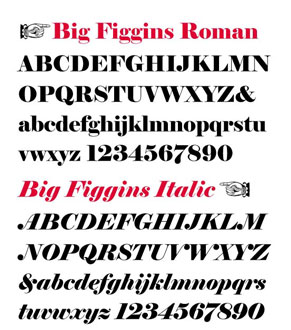
“A number of Matthew Carter’s designs have been based on historical types: ITC Galliard, Big Caslon, Big Figgins, Miller and Vincent among them. Others, like Snell Roundhand and Mantinia, were derived from non-typographic sources from the past. In this lecture he explains his debt to the historical legacy — especially to the resources of St Bride’s. His type revivals have varied in faithfulness to their models, which raises questions about the responsibilities of the continuator of traditional forms, about degrees of interpretation, adaptation to current technology, ancestor worship and travesty.”

Update: All sold out now. Hopefully you acted fast and I’ll see you there. Meanwhile, here’s a nice article about Carter from the Washington Post (nothing new if you already know who he is, but it’s nice), since it looks like he’s doing a talk in DC next week (also sold out).

Louche decadence

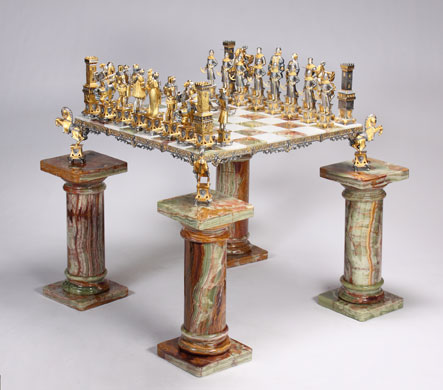
As far as cultural commentary goes. I realize that I’m really grabbing at the low-hanging fruit to point out that Michael Jackson’s Neverland Ranch auction is a long-awaited glimpse at the sheer, unadulterated crazy that is the King of Pop’s approach to life. The gallery of selected offerings scratches the surface of a story about questionable taste, obscene wealth, stunted maturity, and an attempt to keep reality at bay.

Michael Jackson's auction

The thing is, the story of the Yves Saint Laurent auction has a lot of parallel themes, although I’d venture to say Laurent’s taste was infinitely better, and there’s a very different vibe to an estate auction in comparison to a living person auctioning off the trappings of a chapter in his life he wants to forget. (And honestly, Michael, I can sympathize with that.)

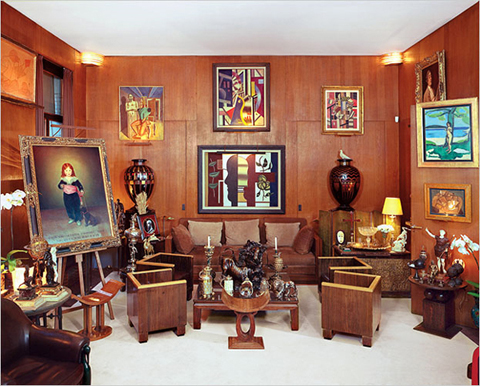
There’s something very enticing about this description of Laurent’s things from a photographer reviewing them: “I have an affinity for louche decadence, which is one of the things on view here,” Pierson says. “There is a very opium-den quality — all those tables full of objects one can peruse in a haze.” It’s less enticing to picture Jackson’s “armour, display cases of custom-made crowns and an ornately carved throne with red velvet upholstering in his bedroom.” However, reading about the two auctions made me feel a bit sad, and I saw some eerie parallels in the way two very different, very wealthy men seemed to rely on so much stuff to keep at bay an overwhelming world around them.

“The innumerable representations of serpents and birds that Saint Laurent amassed, symbols of an obsession with a natural world from which, toward the end of his life, he became increasingly removed” do not seem so altogether different from Jackson’s infamous menagerie. “Saint Laurent was not the first person to apprehend that genius can often be a curse. Neither was he the first to withdraw from society, in all its disappointing dimensions, into the fixed and reassuring company of things.” Also, clearly, he was not the last.

Et tu, Kim’s?

I was immediately fascinated by this unusual story of how the entire collection of over 55,000 rental titles from the deservedly famous Kim’s Video store has been packed up and shipped to Salemi, a small town in Siciliy that is trying to reinvent itself as a cultural haven. I saw the story late last night, and sent links to it to a couple of friends who might get a kick out of it: one a film buff I know here in the UK, the others good friends of mine who have also left New York after growing up there.

The thought of the Kim’s collection stayed with me until the morning, although I couldn’t quite put my finger on the reason why. I had never actually been a member of Kim’s, and I was rarely a customer. The thing is, though, I always thought of it as a veritable museum of film, and I loved it just for being there. I loved the way the store was organized, grouping films by director or startlingly specific genres. I loved that they rented boldly pirated copies of obscure old and foreign works that weren’t available for general release in New York. I loved that it was useful as an educational resource for me as a film lover as much as it was a store.

I think it was this last aspect that made it seem so perfect to the researcher in me that the collection was shipped off intact. Just knowing it exists somewhere as a body of work is soothing. It’s obvious that Yongman Kim, founder of the store, is a true lover film, regardless of whatever he needs to do as a businessman to support himself. When he was realizing that Kim’s could He promised to donate all the films without charge to anyone who would meet three conditions: Keep the collection intact, continue to update it and make it accessible to Kim’s members and others.”

My friend Mark wrote this morning and immediately put his finger on what was so resonant about all this for me. There’s no point in paraphrasing when he summed it up so well, as always:

While there will always be pockets of NYC that resemble the NY of our teen years, in spirit, it seems a wholly different place to me. The most disconcerting thing is that the places that are relocating/shutting down now aren’t just places I used to go, but places that I had identified as being uniquely of NY, but that is obviously no longer so.

It is amazing though that these things and places are being scattered around the world, and not simply ceasing to exist, as if confirming just how valuable these things are, but just no longer valuable to New York or New Yorkers.


Random wonderful things

I’ve been bedridden for days, so my already active trawling of the web has really gone off the charts. Here are a few gems that I feel compelled to share:

  • The “I Can Read Movies” Series: these imaginary paperback novelizations of hit movies are so beautiful and mid-century perfect they bring a tear to my eye.

  • Comics Grammar & Tradition: I moan about some of the typographic conventions in comics, but I can at least acknowledge that many of them are at least reliable conventions. Here’s a good guide to what they are.

  • Paul’s Boutique, remastered: The Beastie Boys finally re-release one of my all-time favorite records, one that completely blew me away from the first instant I heard it. The accompanying site is Flash-heavy, but filled with good stuff, including a free commentary track of the B-Boys telling stories about the tracks as the entire record plays.

  • Chip Steele, R.I.P.: Chip Steele has been a bit of legend to me for a long-time, ever since my pal Dave went sky-diving with him. If you’re going to jump from a plane, you want a man named Chip Steele strapped to your back! Unfortunately, Steele had a fatal mid-air heart attack while giving a lesson to a young Army private, soon after uttering these now-immortal words: “Welcome to my world.” Pvt. Pharr then landed himself safely, but was unable to revive Steele. If I have ever heard a good premise for a bro-mantic action movie, this is it.

Teaching new dogs old tricks

My associate Mr. Moore — a popular but occasionally controversial contributor to Design Assembly — has written another great piece. This time around he’s kicking off what will hopefully be a series of “old book reviews” by considering the pearls of wisdom contained in Carl Dair’s 1952 book Design with Type.

And if your curiosity is piqued after reading Ian’s review, you can also find the whole thing preserved at Google Book Search.

Magical mystery tub

I’m reading my way through a stack of old issues of Metropolis (my sister recently handed me all the back issues from my subscription that she received after I left the country in September ’06), and this Susan Szenasy editorial from March 2007 really resonated with me.

I love having a good soak in a a good tub, a pleasure that’s become an acute craving now that I can’t even guarantee a quick shower with hot water in the shithole where I currently live. Oaklands had a pretty spectacular tub, but even that was easily surpassed by the at my friend’s flat where I house-sit from time to time. That one is pure heaven.

I agree with Szenasy’s basic requirements for a good tub: deep, made of metal rather than plastic, with a good angle for reclining. I’d add one more feature that can make or break a good bath for me: natural light. There’s something about a generous flood of natural light — even weak, midwinter British light — that completes the experience for me.

Sometimes a nice, hot bath can be so perfectly relaxing that I struggle with it. I’m so used to being tense and stressed out that I can feel my whole body rebel against the relaxing effects of a long, hot soak. In a twisted way, I have to concentrate on letting myself unwind. Sad, but true.

The Internet says I know something

It gives me a mild flash of nerdy glee to know that I am now cited as a source for information in not one but two articles on Wikipedia. If you ever have any need or desire to read about Microsoft’s Cambria typeface or the ubiquitous Times Roman, you will find sections of those articles that draw directly from my MA dissertation on typefaces for mathematics.

It’s flattering, of course, but it’s also the kind of thing that reminds me that while Wikipedia is exceptionally useful, articles you find there are not actually great citations in themselves. Information on Wikipedia is supposed to be verifiable. That is, it should ideally point to another source to back up what it says there. In the case of my two citations, Wikipedia points to my dissertation (kindly hosted at Mark Jamra’s fantastic Type Culture site). Even that, though, is not a primary source, since everything I wrote is the result of research looking back to the actual primary sources. So the articles on Wikipedia are — in this case, and in many others — references to references to sources, not reliable information in and of themselves. They’re useful, sure, but just starting points if you’re really trying to get to the bottom of something.